Engineering Low-Latency Trading Platforms: Lessons from Jabil & Intel’s Latest STAC-N1 Results
Sep 28, 2026



Low-latency infrastructure has always been a competitive advantage in electronic trading, but today's market participants are looking beyond headline latency numbers. Consistency, determinism, scalability, and operational repeatability have become equally important considerations as firms evaluate the platforms that support their trading operations.
Recent STAC-N1 benchmark testing using Intel® Xeon® processors, AMD Solarflare networking, and Jabil’s J322-S platform produced industry-leading, publicly disclosed latency results across several key metrics. But the benchmark tells only part of the story.
To examine the architecture behind those results and their relevance to real-world trading environments, Derek Kelly, a system architect at Jabil, and Phil King, a principal engineer at Intel, sat down to discuss platform design, determinism, deployment at scale, lifecycle management, and the future of low-latency infrastructure.
Q1: The benchmark results are impressive, but what matters most for a trading firm: absolute latency or determinism?
DEREK KELLY: Both matter, but determinism is often what separates a fast system from a truly effective low-latency platform.
In electronic trading, an occasional latency spike can be more damaging than a slightly higher average because the system may be acting on market data that is already stale. That is why we focus heavily on the complete latency distribution — not just mean or median latency, but P99, maximum latency, and standard deviation.
The STAC-N1 testing showed that the Jabil and Intel solution performed strongly across all of those measurements, including under the highest tested message rates. For customers, that means performance that is not only fast but also highly deterministic as workloads become more demanding.
Jabil also validates performance at the complete server level prior to shipment, helping ensure that customers receive a platform that performs as an integrated system rather than simply a collection of high-performance components.
PHIL KING: We agree that both metrics matter, but many trading firms ultimately evaluate success based on how consistently a platform responds under real-world conditions. Low average latency is valuable, but predictable latency is what allows trading applications to be tuned, tested, and deployed with confidence.
From a platform-design perspective, determinism is not the result of any single component. It emerges from how the processor, memory subsystem, networking stack, operating system, and application interact. Unexpected latency variation can originate from many sources, including cache misses, NUMA effects, interrupt handling, memory access patterns, and contention for shared resources.
This is why modern low-latency environments focus on platform-level optimization rather than simply selecting the fastest processor or network adapter. Technologies such as NUMA-aware placement, CPU isolation, affinity tuning, kernel-bypass networking, and coordinated hardware and software configuration help reduce variability and improve consistency.
The STAC-N1 results highlight what is possible when the entire system is engineered with these objectives in mind. The combination of Intel® Xeon® processors, Jabil server architecture, and a carefully optimized software stack delivered both low latency and highly consistent behavior across a range of tested message rates.
Q2: How does Jabil's server architecture help reduce latency and improve determinism beyond the choice of CPU and NIC?
KELLY: One of the key design principles behind the Jabil platform is keeping the data path as direct as possible.
The architecture does not rely on PCIe switches, expanders, or retimers between the processor and latency-sensitive PCIe devices. Devices such as the network adapter connect directly to CPU PCIe lanes, helping avoid unnecessary components and additional hops in the I/O path.
For low-latency workloads, that architectural simplicity matters. Additional devices in the path can introduce more complexity, more firmware dependencies, and more potential sources of contention or variability.
Combined with the Intel® Xeon® processor architecture, careful PCIe device placement, memory configuration, BIOS tuning, power delivery, and thermal design, Jabil's approach is to eliminate unnecessary complexity wherever possible and optimize the server as a complete system.
The result is an architecture designed not only for low latency, but for highly deterministic latency, this is particularly important in electronic trading, where outliers can matter as much as averages.
KING: Jabil's architectural approach aligns closely with what we see in many of the world's most performance-sensitive computing environments: reducing unnecessary variability at every layer of the system.
While direct PCIe connectivity and efficient device placement are important, achieving deterministic latency also depends on how effectively the processor, memory subsystem, and I/O resources work together. Factors such as NUMA locality, memory access patterns, interrupt routing, cache behavior, and CPU affinity can all influence application response times.
A simplified server architecture makes it easier to fully leverage the capabilities of Intel® Xeon® processors because software, memory, and networking resources can be aligned more predictably with the underlying hardware topology. This allows applications to benefit from more consistent memory access characteristics, reduced cross-domain communication, and improved resource locality.
In low-latency environments, performance is rarely determined by a single component. The strongest results typically come from a platform where the processor architecture, server design, networking configuration, operating system, and application have all been optimized as a coordinated system. We see that in the STAC-N1 results.
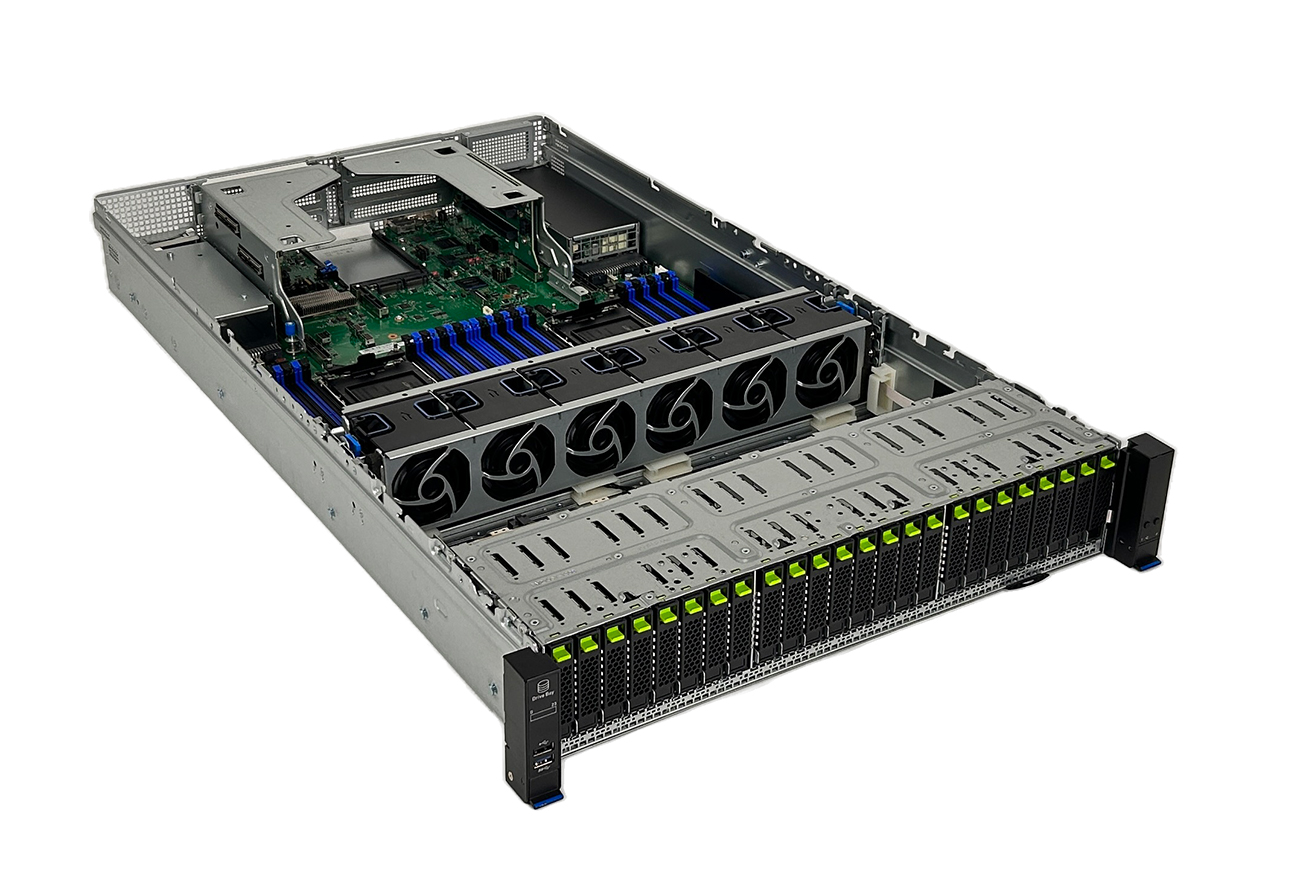
Jabil’s J322-S server, used to produce industry-leading low latency results in recent STAC-N1 benchmark testing.
Q3: How much of low-latency performance comes from the CPU and NIC vs. platform-level engineering?
KELLY: Low-latency performance is fundamentally a system-level problem. Processor architecture is extremely important, but so are PCIe topology, NIC placement, memory architecture, BIOS settings, firmware, power and thermal behavior, and the physical implementation of the server itself.
The tested configuration combines 5th Gen Intel® Xeon® Scalable processors, AMD Solarflare X4542-PLUS network adapters, and Jabil's J322-S platform. The objective was not simply to combine fast components. It was to engineer and tune them as a complete low-latency system.
That system-level optimization is where Jabil adds significant value. We focus on sustained and predictable performance, without relying on overclocking or unnecessarily complex cooling approaches, while minimizing sources of variability across the platform.
KING: The benchmark results reflect the contribution of every major layer in the system. High-performance processors, low-latency networking, and a well-designed server platform are all necessary, but none alone is sufficient to achieve the latency and consistency demonstrated in the STAC-N1 results.
In our experience, low-latency performance is often limited not by any individual component, but by interactions between compute, memory, I/O, software, and application design. When those elements are aligned, the resulting performance can significantly exceed what would be expected from examining any single specification in isolation.
The results show that Intel® Xeon® processors, AMD Solarflare networking, and Jabil's platform architecture each contribute meaningfully, but the greatest benefit comes from how they are engineered and tuned to work together.
Q4: Why use 5th Gen Intel® Xeon® when newer processor generations are available?
KELLY: For low-latency workloads, newer does not automatically mean better. The 5th Gen Intel® Xeon® Scalable processor used in this solution employs a monolithic die architecture that reduces the number of interconnect hops data may need to traverse between the network interface and CPU caches. That can provide a meaningful advantage in workloads where nanoseconds matter.
This is also an important part of Jabil's design philosophy. We select platforms based on workload behavior rather than simply choosing the newest available technology.
For a trading customer, the right architecture is the one that delivers the best combination of latency, determinism, compute density, scalability, and operational stability.
KING: The assumption that newer processors automatically deliver the lowest latency is not always correct. Low-latency trading environments are highly specialized, and the architectural characteristics that matter most can differ from those that optimize for cloud-scale throughput, virtualization density, or AI workloads. These workloads often reward simplicity and predictability as much as raw compute capability.
When combined with the Jabil J322-S platform, direct-attached low-latency networking, and extensive system-level optimization, it delivered excellent results across both latency and latency-consistency metrics.
Q5: How does this platform behave when message rates increase or markets become more volatile?
KELLY: That was one of the most important aspects of the testing. At the highest tested rates — 1.4 million messages per second for 264-byte messages and 1.5 million messages per second for 66-byte messages — the Jabil and Intel solution delivered the lowest mean, median, P99, maximum latency, and standard deviation among the comparable publicly disclosed systems cited in the test.
That matters because trading infrastructure is rarely stressed during quiet market conditions. The real test is how the platform behaves during bursts, opening and closing periods, major market events, or other conditions where traffic and strategy activity increase sharply.
The objective is not simply to remain fast. It is to maintain deterministic performance precisely when the workload becomes least predictable.
KING: One of the realities of low-latency computing is that maintaining performance at high message rates is often more difficult than achieving low latency under lightly loaded conditions. As message rates increase, demands on processor caches, memory bandwidth, I/O resources, and operating-system services increase as well. If any of those become constrained, latency variation and outliers can increase rapidly.
For that reason, low-latency platforms must be evaluated across a range of operating conditions rather than at a single point in time. The most successful systems are those that maintain consistent behavior as utilization rises, not simply those that achieve an impressive result under ideal conditions.
For trading firms, the goal is not simply to process more messages. It is to maintain confidence that application response times remain predictable as workloads become more demanding.
Q6: What makes STAC-N1 a meaningful benchmark for evaluating real-world trading infrastructure?
KELLY: STAC-N1 is meaningful because it evaluates the performance of the complete host network stack under market-data-style workloads rather than measuring a single component in isolation.
That matters because trading performance depends on how efficiently data moves through the entire system, from the network adapter, across PCIe, through the processor and memory subsystem, and ultimately to the application. STAC-N1 exercises that path across different message sizes and traffic rates while measuring mean, median, P99, maximum latency, and standard deviation.
For trading firms, those metrics are especially important because the fastest average result is not always the most valuable result. What matters is whether the platform can maintain low and deterministic latency as message rates increase and market conditions become more demanding.
That makes STAC-N1 particularly relevant to the Jabil and Intel solution because it evaluates the kind of system-level behavior we are engineering for: CPU architecture, PCIe topology, direct-attached I/O, NIC placement, BIOS, firmware, memory, power, and thermal design all working together as a complete platform.
KING: I agree with Derek's assessment. One of the reasons STAC-N1 is so valuable is that it measures platform behavior under workload conditions that are much closer to what trading firms encounter in production. Rather than focusing on an isolated component or a single latency measurement, STAC-N1 evaluates how the entire system responds as message sizes and traffic rates increase.
From an Intel perspective, that is important because the most challenging problem in low-latency trading is not achieving a fast result once. It is maintaining low and predictable latency while processing increasingly demanding market-data volumes. STAC-N1 measures both latency and throughput, allowing firms to understand how a platform behaves when it is actually busy.
The benchmark also helps expose the benefits of platform-level optimization across processor architecture, cache and memory behavior, I/O connectivity, NUMA locality, networking, and software tuning. For trading firms, that provides a more meaningful view of real-world performance than isolated component specifications or peak benchmark numbers alone.
Q7: Benchmark systems can be highly optimized. How does Jabil turn this into something customers can actually deploy at scale?
KELLY: A benchmark establishes what the architecture is capable of. The next challenge is making that performance repeatable. That is where Jabil's server engineering, validation, integration, and manufacturing capabilities become important.
We design platforms around specific workload requirements and then control the hardware configuration, firmware, BIOS settings, PCIe topology, thermal environment, power delivery, and manufacturing implementation required to reproduce that architecture consistently. For a customer deploying hundreds or thousands of systems, configuration consistency and repeatability matter nearly as much as the performance of a single server.
Jabil can also deliver these systems in a turnkey, appliance-style model, including custom rack-level integration and validation where required. The goal is to reduce the amount of integration work customers need to perform after delivery and make deployment as predictable as the performance of the system itself.
Q8: Why does Intel place so much emphasis on platform topology and resource locality for trading workloads?
KING: In low-latency trading environments, data movement often matters as much as raw compute performance. Every time data crosses a NUMA boundary, accesses remote memory, or competes for shared resources, additional latency and variability can be introduced.
That is why Intel focuses heavily on platform topology and resource locality. The goal is to keep processors, memory, networking, and applications aligned in a way that minimizes unnecessary data movement and reduces latency variation.
From Intel's perspective, some of the largest gains come not from increasing clock speed, but from improving how efficiently the entire platform moves and processes data. Processor architecture, cache behavior, memory access, PCIe connectivity, and workload placement all contribute to how predictably an application performs under load. The STAC-N1 benchmark helps quantify those effects, providing firms with a practical view of how platform-level optimizations translate into both low latency and consistent performance.
Q9: Why would a trading firm choose a purpose-built Jabil platform instead of buying a general-purpose server and tuning it internally?
KELLY: General-purpose servers are designed to satisfy a very broad range of workloads. Low-latency trading is almost the opposite problem: every architectural choice can matter.
A purpose-built platform gives us the ability to optimize around the customer's actual workload - processor choice, network adapters, PCIe placement, memory configuration, firmware, cooling, power, and system topology rather than accepting compromises required by a general-purpose design.
Unlike many general-purpose platforms that use PCIe switches, retimers, or other expansion components to maximize connectivity, Jabil can optimize the architecture around direct CPU-attached I/O where latency and determinism are the priority.
Just as importantly, Jabil works directly with customers' engineering teams throughout the design and deployment process. For customers with sophisticated internal infrastructure organizations, we view that relationship as collaborative. Jabil effectively becomes an extension of the customer's engineering team.
That allows us to build around the trading environment rather than forcing the trading environment to adapt to a standardized server.
KING: Many trading firms have highly sophisticated engineering organizations and are fully capable of tuning infrastructure internally. The question is often not whether they can do it, but how much time and effort they want to invest in solving infrastructure challenges that are already well understood.
We see the value of this approach in the STAC-N1 results. The combination of Intel® Xeon® processors, AMD Solarflare networking, and the Jabil J322-S platform was optimized as a complete solution, allowing customers to focus more of their engineering resources on trading applications and business logic rather than underlying infrastructure integration.
Q10: Low latency is important, but financial institutions also care about reliability, standardization, and platform lifecycle. How do you address those requirements?
KELLY: Performance cannot come at the expense of operational stability. Financial-services infrastructure may remain in production for years and may be deployed across multiple data centers or global locations. Component availability, firmware control, thermal margins, manufacturing consistency, infrastructure standardization, and lifecycle planning therefore all have to be considered alongside benchmark performance.
Jabil's role extends beyond the initial server design. We can support the platform across its lifecycle — from design and deployment through service, refresh, and eventual retirement.
That continuity is particularly valuable in low-latency environments because seemingly small hardware or firmware changes can alter system behavior. Maintaining tight configuration control helps customers preserve the latency and determinism characteristics they originally qualified while standardizing infrastructure across sites.
KING: Reliability and platform stability are often overlooked when discussing low-latency infrastructure, but they are critical to long-term success. Trading firms do not deploy servers for a benchmark run. They deploy infrastructure that may remain in production for many years while supporting evolving applications, changing market conditions, and ongoing operational requirements.
One of the challenges in low-latency environments is that performance characteristics can be sensitive to hardware revisions, firmware updates, BIOS changes, operating-system updates, and platform configuration. A system that behaves one way during initial qualification can produce different latency characteristics if those variables are not carefully controlled over time.
This is why many financial institutions place significant emphasis on platform consistency, lifecycle management, and validated configurations. The goal is not simply to achieve low latency on day one, but to preserve predictable behavior throughout the operational life of the platform and across multiple datacenter locations.
The combination of Intel® Xeon® processors and a purpose-built platform such as the Jabil J322-S gives customers a validated foundation that balances performance, reliability, and long-term operational stability. In practice, sustaining deterministic behavior over years of deployment can be just as important as achieving an excellent benchmark result in the first place.
Q11: How does Jabil help customers prepare for the next generation of low-latency infrastructure?
KELLY: Low-latency infrastructure is not a one-generation decision. Customers need to understand how processor, networking, memory, I/O, power, and cooling architectures will evolve and how those changes may affect the applications they have already tuned.
Jabil works closely with key technology partners such as Intel and with customers' engineering teams to align current deployments with future platform roadmaps. That collaboration can give customers earlier visibility into upcoming architectures and more time to evaluate, qualify, and plan transitions.
The goal is to provide a platform strategy that customers can evolve over multiple technology cycles, not simply to sell the current generation of hardware.
KING: From Intel's perspective, one of the most important trends is the increasing need to optimize the complete data path. As market data volumes continue to grow and trading systems become more sophisticated, firms will place greater emphasis on reducing system-level bottlenecks, improving resource locality, and maintaining deterministic behavior across increasingly complex environments.
At the same time, many financial institutions are looking for ways to adopt new technologies without disrupting the applications and workflows they have already invested significant effort in tuning and validating. That makes platform continuity, compatibility, and predictable migration paths increasingly important considerations when evaluating future infrastructure.
Preparing for the next generation of low-latency computing requires balancing innovation with operational stability. The most successful organizations are typically those that evaluate emerging technologies early, understand how they align with application requirements, and build a long-term platform strategy rather than treating each hardware refresh as an isolated event.
Q12: What should customers take away from these STAC-N1 results?
KELLY: From Jabil’s perspective, the most important takeaway is that low-latency performance is not determined by one specification or one component.
The results demonstrate what can happen when processor architecture, networking, PCIe topology, system design, and platform engineering are optimized together. The Jabil and Intel solution delivered leading publicly disclosed performance across mean, median, P99, maximum latency, and standard deviation in the tested configurations.
But the broader value goes beyond a benchmark result. Jabil and Intel are working together to deliver platforms engineered around the characteristics that matter in modern electronic trading: speed, determinism, density, repeatability, and operational simplicity. Jabil then extends that value through system-level validation, direct customer engineering collaboration, turnkey deployment capabilities, global infrastructure standardization, and long-term lifecycle ownership.
The result is not simply a fast server. It is a low-latency platform designed to be deployed, operated, and evolved as part of a customer's production trading infrastructure.
KING: The primary takeaway is that low-latency performance should be evaluated as a platform characteristic rather than a component specification.
Much of the industry naturally focuses on processor frequencies, network speeds, core counts, or individual product features. While those elements are important, the STAC-N1 results demonstrate that real-world latency behavior depends on how effectively the entire platform is configured and deployed.
The results also reinforce the importance of looking beyond average latency. The most demanding trading environments care about consistency, predictability, and behavior under load. Metrics such as P99 latency, maximum latency, and latency variation often provide a more complete picture of platform behavior than average latency alone.
Perhaps most importantly, the benchmark demonstrates the value of a workload-first approach to infrastructure design. The best platform is the one that best aligns with the requirements of the workload and delivers predictable performance over time.
Get the full details of the Jabil and Intel solution in the STAC-N1 report here.
How can Jabil help you meet reduce latency in your fintech solution? Contact us.
No matter how complex or demanding the project, Jabil's Intelligent Infrastructure team is helping today’s innovators solve it. Get started with a trusted partner.