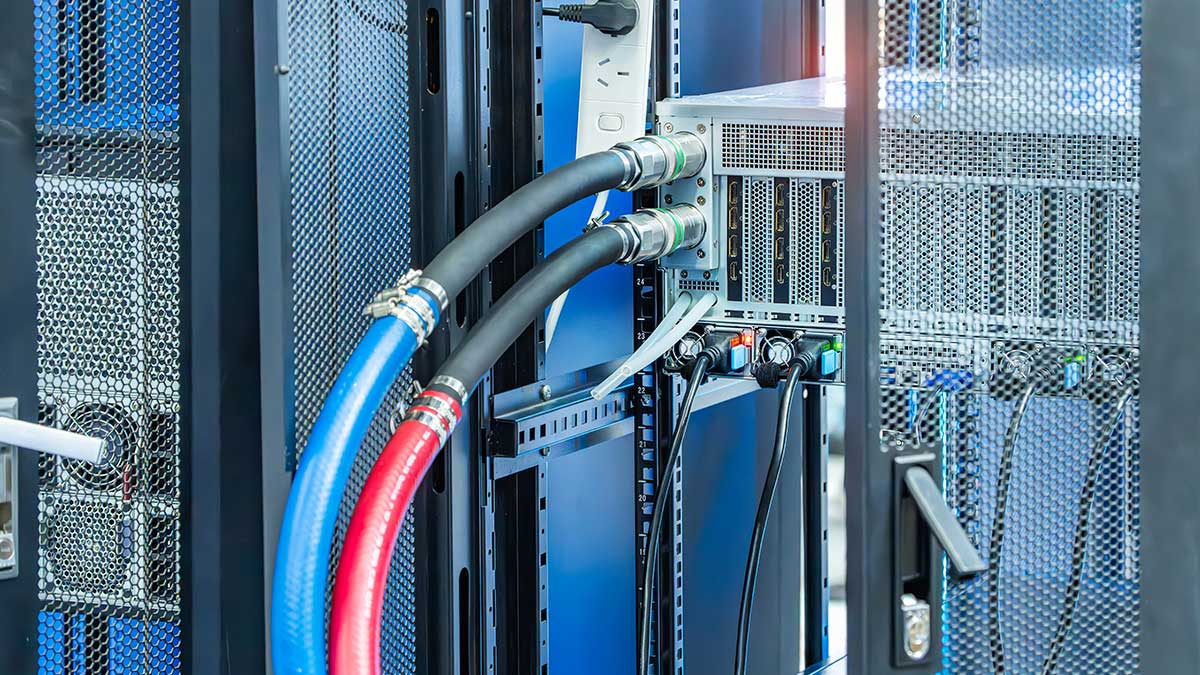

Air cooling has served data centers well for decades. But as rack densities surge with AI workloads, infrastructure designed around air alone is reaching its practical limits.
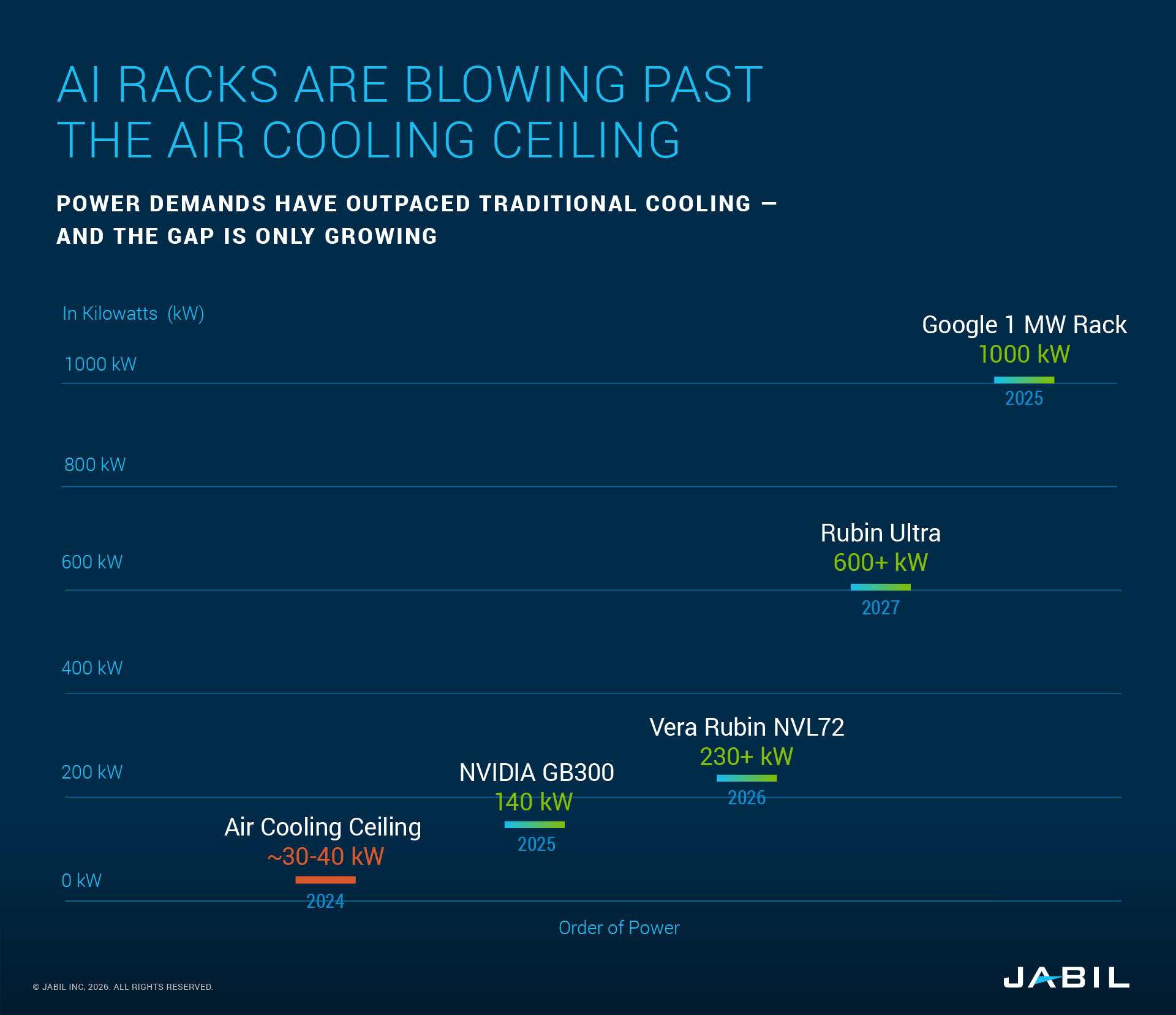
When Nvidia shipped the GB200 NVL72, it didn't ask data centers to adapt. It required liquid cooling as a baseline specification. The server tail stopped wagging the data center dog, as Blackwell GB300 racks hit as much as 140 kW by the end of 2025. Vera Rubin NVL72 racks are projected at 230+ kW in 2026. Rubin Ultra is expected to push above 600 kW in 2027. Google revealed a 1 MW rack design at the 2025 OCP EMEA Summit.
Air cooling's thermal ceiling — roughly 30–40 kW per rack — is so far behind the current trajectory that incremental upgrades aren't a strategy. It becomes a liability, holding back the organization’s ability to scale its infrastructure and meet the needs of today’s AI world.
Direct liquid cooling (DLC) has crossed from niche supercomputing environments into mainstream production. What was ambitious in 2023 is the baseline specification for AI workloads today, and it will become the minimum for even denser GPU deployments in 2026. The global DLC market, valued at over $5 billion last year, is projected to reach over $20 billion in 2029. The direction is settled. The question now is execution.
Real-World Rack Density Challenges
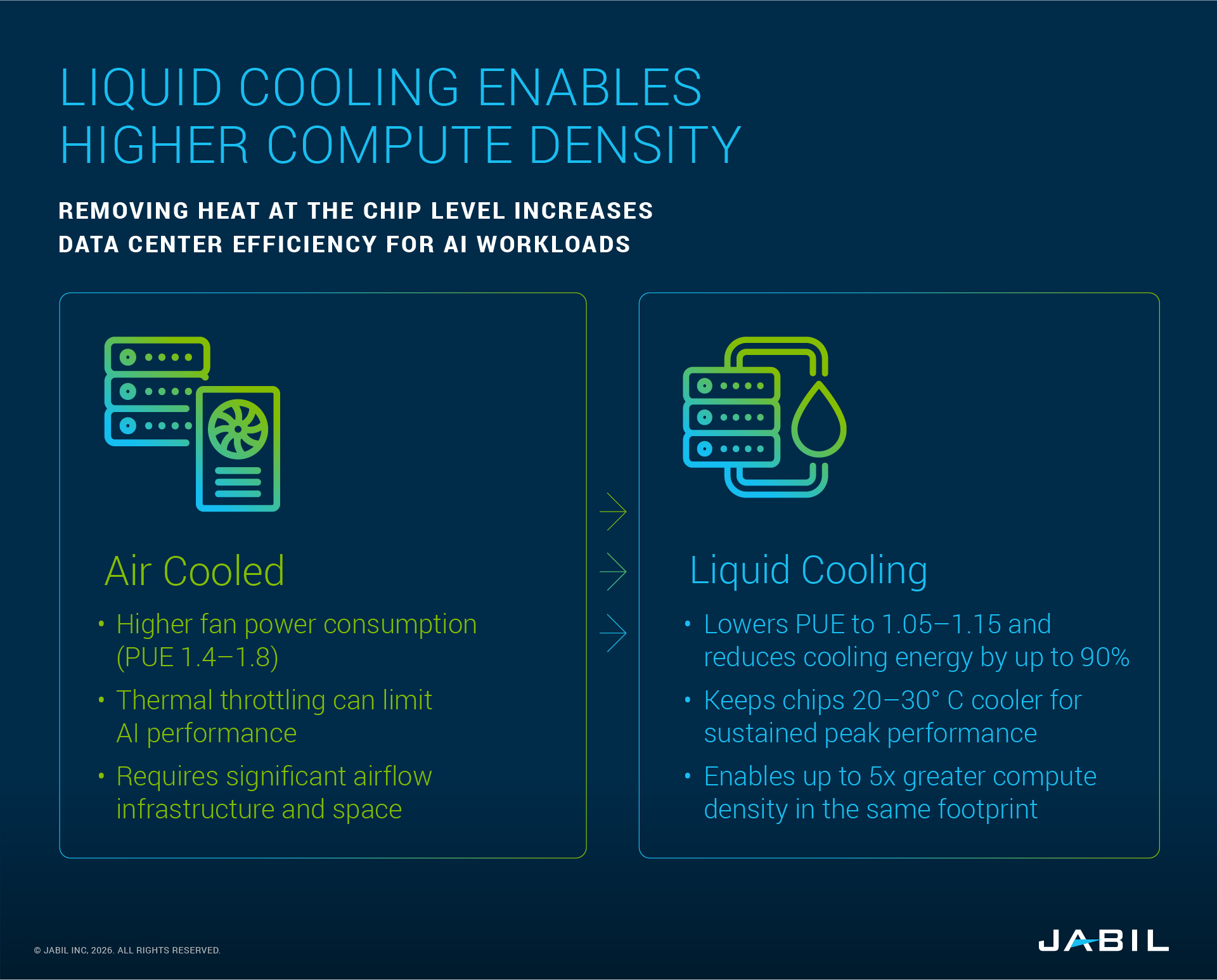
A 700 W chip generates about as much heat as a small space heater — packed into something the size of your palm. Chips at 1,000 W or more are on the near-term horizon. AI and ML server racks that once drew 5–10 kW now routinely exceed 40–100 kW. At 100 kW, a single rack produces more than 340,000 BTU per hour, roughly equivalent to a commercial kitchen at full burn.
Packing that much compute — more GPUs, CPUs, XPUs, network interface cards, more everything — into shrinking real estate reduces cooling headroom and concentrates heat into hotspots that airflow can't easily reach or manage. The 30-40 kW air-cooling threshold isn't a reference point anymore. As a safety measure, thermal throttling cuts directly into compute performance, reducing response times and the amount of tasks-per-second throughput.
Power usage effectiveness (PUE) degrades as the required cooling overhead outpaces compute output. Minor facility retrofits address symptoms but can’t solve the scaling problem presented by AI infrastructure. Liquid-to-air cooling capacity is limited by the power consumption of the rack and still relies on the facility's ambient air to eventually redirect heat outside. The majority of the time this method uses evaporative towers, a huge consumer of facility water.
Water's heat capacity is roughly 3,500 times greater than air per unit volume. DLC transfers thermal energy away from hot components, enabling higher compute densities while reducing overall facility power overhead. For hyperscalers and colos facing constrained grid capacity, that efficiency isn't a future benefit; it's an existing operational necessity.
The case for DLC couldn't be clearer. Executing it at hyperscale, however, is another matter entirely.
Where Liquid Cooling Is and Where It's Going
Three liquid cooling approaches are currently in active deployment and will continue to evolve as data center cooling products mature.
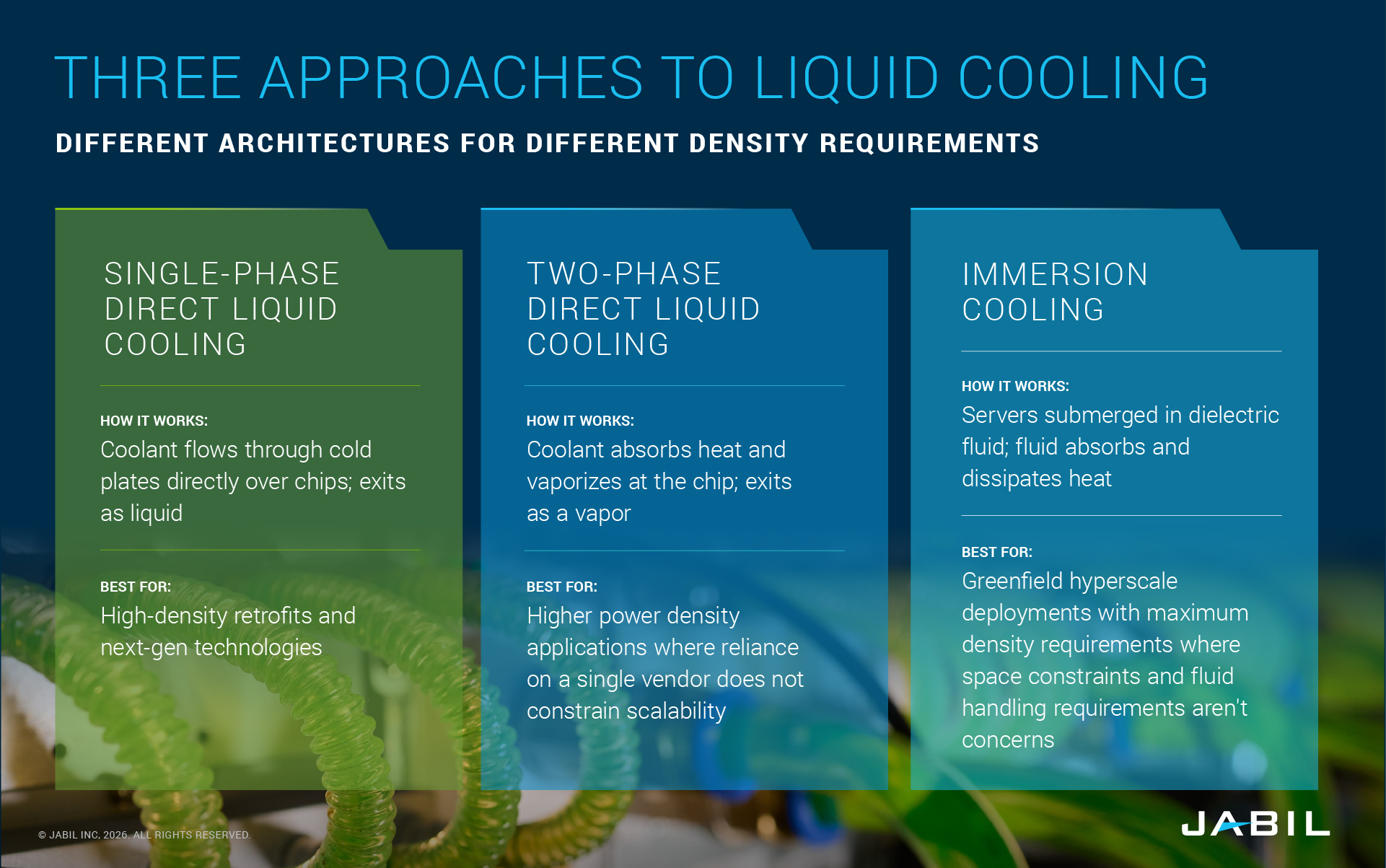
1. Single-phase DLC
In single-phase direct liquid cooling, the coolant circulates through cold plates mounted directly to high-power chips and switches, absorbing heat from these electronics and carrying it to a coolant distribution unit (CDU). These closed-loop systems recycle coolant continuously. The coolant remains liquid throughout the process.
Single-phase DLC is compatible with brownfield and next-gen data center environments because installation is the least complicated of the three approaches. It can be highly efficient, with a few vendors, like Mikros Technologies, a Jabil company, capable of cooling chips up to 5,000+ W in single-phase applications. For the vast majority of current and near-term chip TDPs (thermal design power), single-phase DLC provides sufficient thermal headroom without the infrastructure complexity of alternative approaches.
2. Two-phase DLC
Similarly, two-phase cooling uses a cold plate, often called an evaporator, that is mounted directly to electronics. The liquid coolant flows into the cold plate, absorbing heat and boiling it into a vapor that is then cooled in a condenser and circulated. In these closed-loop systems, the coolant goes through two phases, changing from liquid to gas and then back into a liquid. The phase change absorbs more energy per unit of coolant when compared to most single-phase solutions.
In practice, the thermodynamic advantages become operationally relevant at thermal densities beyond what current chip and next-gen architectures produce. Two-phase infrastructure is more complex and costly, and the engineering maturity gap with single-phase remains significant. As chip TDPs push past current thresholds, two-phase will have a role; for today's deployments, it's a future consideration for most organizations rather than a present requirement.
3. Immersion
Immersion cooling remains niche, accounting for a minority of installs. It involves submerging entire racks, including chips, in non-conductive fluid that draws heat from all components simultaneously. But the operational challenges with this setup are significant. Material compatibility, hardware maintenance procedures, fluid management, added safety protocols, staff training, and risk management all come into play with immersion cooling. Dielectric fluid chemistry isn't fully standardized, and the approach often limits users to a single-vendor commitment.
For greenfield builds with specific workload profiles, immersion is worth evaluating, and some operators are pairing it with direct-to-chip cold plates in hybrid configurations that improve bath efficiency and localized thermal management. It remains a specialized path rather than a default for most.
Liquid-to-liquid cooling systems are becoming the standard for new high-density builds because they can handle rack densities exceeding 100 kW while significantly reducing environmental impact. These solutions address the growing "water-energy nexus" by enabling closed-loop heat rejection that can virtually eliminate the massive water consumption associated with traditional evaporative cooling towers.
Picking the right approach solves the thermal problem. Done well, it's also a pivotal step toward PUE improvements and sustainability wins.
Getting Cooling Right Unlocks PUE Gains
We're in the midst of the data center construction boom, and brownfield facilities are still the most prevalent. Liquid-to-air CDUs, the default option for retrofitted facilities, can extend the life of existing air-cooled infrastructure, but they're ultimately a short-term solution. They don't solve the underlying heat removal problem, and retrofitting will become non-viable as rack densities continue to increase.
Achieving meaningful PUE gains requires designing for liquid cooling integration from day one, in close collaboration with technology partners across the ecosystem — from chipmakers and server OEMs to infrastructure and cooling-system providers. According to McKinsey research, data center capacity is likely to triple by 2030. Meeting that demand will require engineers to think about scalable, liquid-ready cooling architectures now, rather than layering incremental fixes onto legacy designs.
For example, designing co-packaged optics (CPO) with DLC from the beginning of the product lifecycle helps build-in energy efficiency through tailored designs. As transceiver density scales from 800 Gbps speeds — where modules already draw 15-20 W each — to 1.6 Tbps, 3.2 Tbps, and beyond, liquid cooling at the optics layer becomes a baseline requirement. Data centers with thousands of transceivers carry a compounding heat load that liquid-cooled networking and switches can address directly, eliminating in-row air coolers and reducing overall facility cooling load in the process.
Momentum is also growing for standardization across manifolds, coolant chemistry, CDU interfaces, connectors, and coolant specs. The Open Compute Project is working with the industry to align on common standards that simplify system integration and long-term operations. Standardization reduces maintenance complexity, improves serviceability, and interchangeability of components. It also enables more predictable power, thermal, and reliability performance at scale.
Operating at higher inlet temperatures is the most significant lever for improving PUE. Cooling systems designed for warmer inlet coolant temperatures mean chillers work less or are bypassed entirely in favor of dry coolers or free coolers that use outside air. Liquid-cooled chips and switches remove the need for in-row cooling, significantly reducing the overall air-cooling load at the facility level.
Thinking intentionally about design specifications is the only way to scale up efficiently and counterbalance the energy usage trajectory.
What the Spec Sheet Won't Tell You
Liquid cooling is clearly the future for modern data center infrastructure. The challenge isn’t the technology itself; it’s deploying it reliably at hyperscale, across facilities, and under real-world operational conditions. That’s where the complexity truly begins and where most technical data sheets stop being useful.
Currently there are no industry-wide testing standards, but they are forthcoming. In their absence, engineers, manufacturers, and integrators must develop independent testing protocols.
Without a common specification, especially around test rig cleanliness, this inconsistency creates a trickle-down effect:
- No standard filtration or rig cleanliness protocol.
- No common validation methods for leak-free systems.
- No shared baseline for what constitutes a passing test.
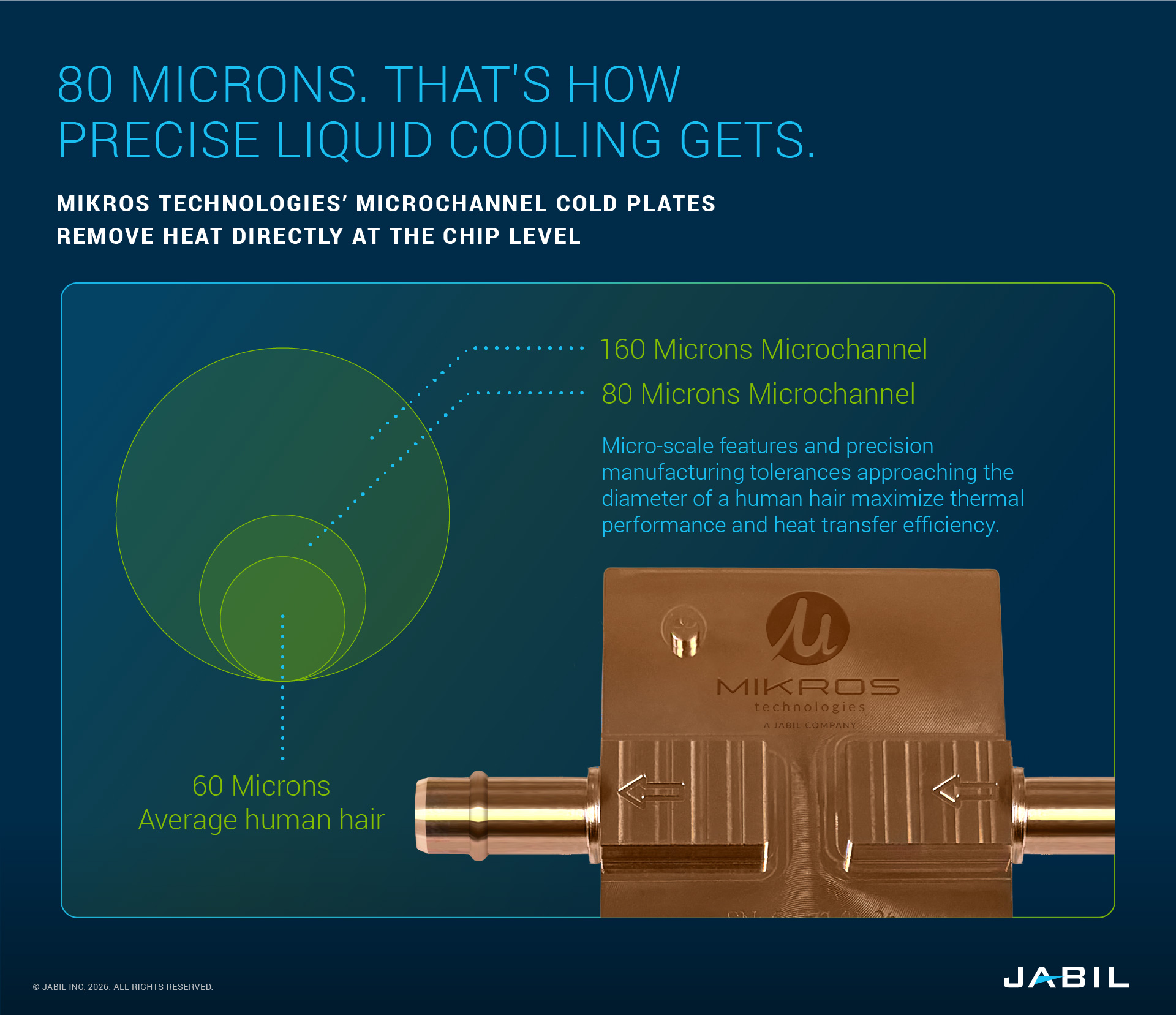
Generally, microchannel cold plates, with channel dimensions of 160 microns or smaller, are vulnerable to clogging. Additionally, any contamination introduced during testing carries directly into deployed systems. This is why Mikros Technologies builds and validates its 160 and 80 micron microchannel cold plates to the cleanliness standards its own microchannel geometry demands. The broader industry hasn't yet agreed on these testing standards.
Mikros Technologies goes further by engineering reliability into the cold plate design, rather than treating it as a downstream test result. These microchannel cold plates are meticulously machined and joined using vacuum furnace brazing. A low-pressure, high‑cleanliness process eliminates flux contamination and creates structurally sound, leak‑free joints well suited for long‑term operation in demanding thermal environments.
Additionally, to validate integrity at a molecular level, cold plates undergo helium leak testing. Helium molecules are smaller than water and other liquid coolant molecules, making this approach an exceptionally sensitive indicator of leak tightness before deployment.
If cold plate validation protocols aren’t executed effectively, there's no reliable way to know whether the hardware will hold up in deployment. This makes troubleshooting nearly impossible. Additionally, AI servers compound risk. Unlike traditional infrastructure, they don't degrade gracefully under thermal stress; they shut down immediately. CDUs must be adequately sized and on backup power. Operators need to balance CDU redundancy against cost and the blast radius impact: fewer CDUs reduce complexity but increase the scope of any single failure.
Liquid cooling supply chains are maturing fast, with vendors like Vertiv and Schneider Electric offering full modular solutions that didn't exist a few years ago. But modular doesn't mean plug-and-play. Integration decisions are made early in a project to determine whether those solutions perform at hyperscale or create bottlenecks down the line.
Aspiration vs. Execution
It's one thing to have the technical know-how for liquid cooling. It's another to deploy it with manufacturing discipline and rigor at hyperscale. There are only a handful of partners globally with production-scale experience and the depth needed to manufacture liquid-cooled servers reliably. Jabil is one, capable of full-stack integration from cold plate to facility loop, with engineering, design, and development capabilities.
Most of the industry considers liquid cooling as a facility upgrade, a CDU selection, or a mechanical design challenge. That framing underestimates where deployments actually break down. Liquid cooling becomes viable for AI data centers only when it's manufacturable, testable, deployable, and serviceable at hyperscale. The gap between "it works in the lab" and "we can deploy 100,000 of these globally" is where most solutions fall short.
Jabil's acquisition of Mikros Technologies brings patented microchannel cold plate IP into a full-stack manufacturing capability. Mikros Technologies' Mikromatrix platform employs single-phase, direct liquid cooling that can be adapted for two-phase cooling applications. Its architecture incorporates a rectangular array of microchannels, oriented perpendicular to the surface being cooled, maximizing coolant contact area within the cold plate for efficient heat dissipation. The design ensures uniform coolant distribution and enables targeted cooling aligned with processor heat maps. This contrasts with parallel-flow or finned designs that create pressure drops and uneven temperature gradients.
With microchannels at 160 microns or smaller, thin-profiled designs optimized for 1U, and void fractions between 30–50% of cold plate volume enable thermal flux capacity exceeding 1,000 W per square centimeter with near-zero temperature differential across the active die surface. Zonal cooling tailors flow rates to match real-world heat maps: more coolant to high-density 300–500 W/cm² compute cores, less where heat loads are lower, with reduced pumping energy throughout.
Broadcom's 3.5D XDSiP platform is one example of where this capability is ready. Designed for gigawatt-scale AI clusters, the 3.5D XDSiP combines 2.5D and 3D-IC integration to deliver a 7x increase in interconnect density and a 10x reduction in die-to-die power consumption. At 5,000 W TDP, the platform requires precision chip-level cooling in a 1U profile. Mikros Technologies' cold plate provides the thermal resistance needed to keep that silicon running at full performance across high-density rack deployments.
That IP matters. What makes it deployable at hyperscale is the manufacturing infrastructure behind it: co-design across cold plates, manifolds, server chassis, and rack systems; factory-level pressure, leak, and thermal validation; automotive-grade reliability standards; and end-to-end traceability. Jabil also works across suppliers and standardizes integration without dictating component choices — ecosystem neutrality without vendor lock-in. When customers scale to hyperscale, that infrastructure is already proven.
Co-designing liquid cooling with compute, rather than retrofitting it afterward, reduces integration complexity, lowers system cost, and accelerates deployment cycles. It also positions operators for the transitions ahead, as AI silicon generations change cooling requirements faster than most infrastructure roadmaps are built to accommodate.
Density Is the Roadmap
Today's chips are not the thermal ceiling. Liquid-cooled networking, co-packaged silicon, and optics are next. The operators and manufacturers who treat liquid cooling as a foundational infrastructure decision, rather than a hardware upgrade, will win the compute race.
The density curve isn't leveling off. The only variable is whether your infrastructure is ahead of it or behind it.
How can Jabil help you meet your liquid cooling goals? Contact us.
No matter how complex or demanding the project, Jabil's Intelligent Infrastructure team is helping today’s innovators solve it. Get started with a trusted partner.