

Since the discovery of how microorganisms cause infection, sterilization has been foundational to the healthcare industry, helping to ensure patient safety and product performance.
For decades, medical device manufacturers have relied on ethylene oxide (EtO) gas sterilization, valued for its versatility, materials compatibility, and proven effectiveness. But recently, EtO sterilization has come under extensive scrutiny from a range of global regulatory entities, including both the FDA and EPA in the United States.
Facility shutdowns linked to environmental and safety concerns have revealed how fragile dependence on a single mode of sterilization can be. Gamma irradiation has offered a viable alternative, yet it too faces constraints due to vulnerabilities in the global supply of cobalt-60, the radioactive isotope required for the process.
The industry now stands at a crossroads. Single, or even dual, sterilization modalities may no longer guarantee uninterrupted delivery of sterile medical equipment for the patients who depend on it.
Global Demand for Medical Sterilization Is Surging. What’s Driving It?
First, an important distinction. Sterilization is a validated process designed to eliminate all forms of viable microorganisms — including highly resistant bacterial spores — to achieve a defined sterility assurance level (SAL). In contrast, disinfection only reduces the number of viable pathogens. This is why sterilization is so critical to combating healthcare-associated infections (HAIs), which remain a persistent and costly burden on health systems worldwide.
Aging demographics and the rise in chronic disease are major factors behind the increased demand for surgical procedures and greater adoption of single-use medical devices and instruments. Utilization of new care settings like ambulatory surgical centers (ASCs) — while proving highly effective in reducing overall healthcare costs — are an additional driver of demand for sterilized medical devices.
Roughly 40% of the more than 2 million medical devices listed in the Global Unique Device Identification Database (GUDID) database published by the U.S. Food and Drug Administration (FDA) are sterilized before they reach end-users and patients.
At a time when expectations for cost efficiency and accelerated time-to-market across the medical device marketplace are higher than ever, how do the millions of FDA-regulated products, and millions more around the world, get sterilized? Where and when does sterilization take place? And how are these processes best managed to ensure consistent supply of medical products to the patients who need them?
The Major Sterilization Modalities and Their Market Share
Ethylene oxide (EtO) has long been the workhorse of the industry. First synthesized in the mid-1800s and adopted for industrial sterilization in the decades following World War II, EtO has since become deeply embedded in medical device manufacturing. Prized for its ability to penetrate complex geometries and packaged configurations at low temperatures, EtO gas sterilization accommodates a wide range of materials commonly used in medical devices, including plastics, resins, adhesives, metals, glass, and biologics. Many mixed-material devices — especially those combining polymers, adhesives, and electronics — cannot be sterilized by any other method without being damaged or rendered unusable.
Radiation-based sterilization emerged around the same era and has since served as an effective alternative sterilization method for medical devices that do not contain electronics. The most established of these is gamma irradiation, which uses the cobalt-60 isotope to emit high-energy photons that disrupt the DNA of bacteria, viruses, and spores.
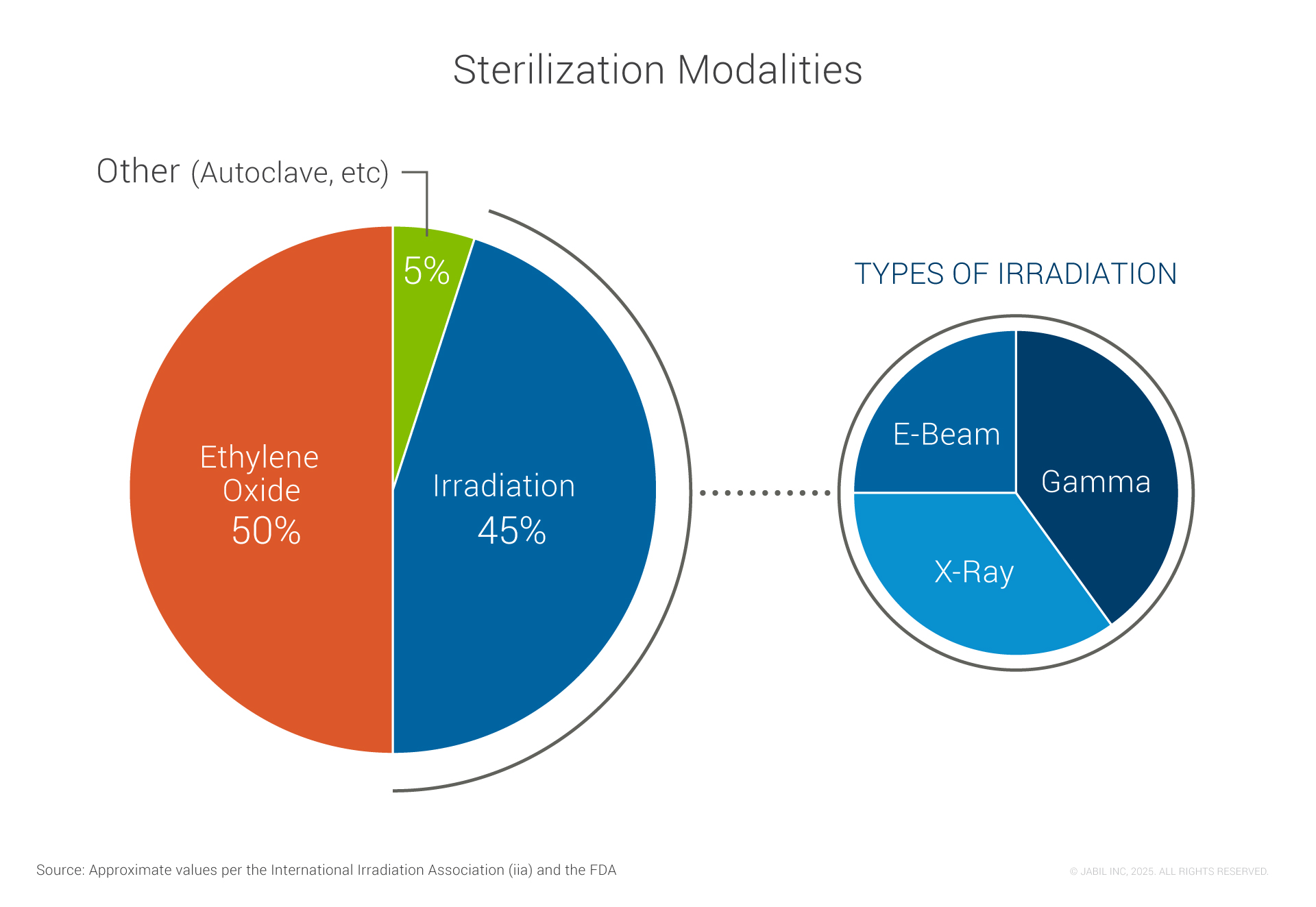
Of the irradiation methods, gamma sterilization is prized for its deep penetration and proven performance across a wide range of product densities and packaging configurations. It is compatible with most materials — including plastics, rubber, metals, and some electronics — and it leaves no chemical residues or toxic byproducts. The process can be fully automated, offers rapid product release through established dosimetry techniques, and operates within a straightforward regulatory framework.
However, gamma’s dependence on cobalt-60 creates its own constraints. With a limited number of global producers and capacity reductions in recent years, supply availability has become a growing concern. Coupled with rising demand, this has placed pressure on processing throughput and costs.
Electron beam (E-beam) sterilization uses a focused stream of high-energy electrons to deliver precisely controlled radiation exposure. Products must pass through a narrow “curtain” of electrons in a single layer to ensure an even dose. As a result, E-beam cannot sterilize entire pallets or very dense assemblies efficiently, but it excels in precision dosing and rapid throughput for lighter, final-packaged goods.
X-ray sterilization uses high-energy photons generated by converting an electron beam into X-rays when it strikes a metal target. This process combines the deep penetration of gamma radiation with the controllability and on-demand operation of an electrically powered system. Like other irradiation methods, X-ray is a non-thermal, dry, residue-free process that is compatible with a wide range of materials and final-packaged devices.
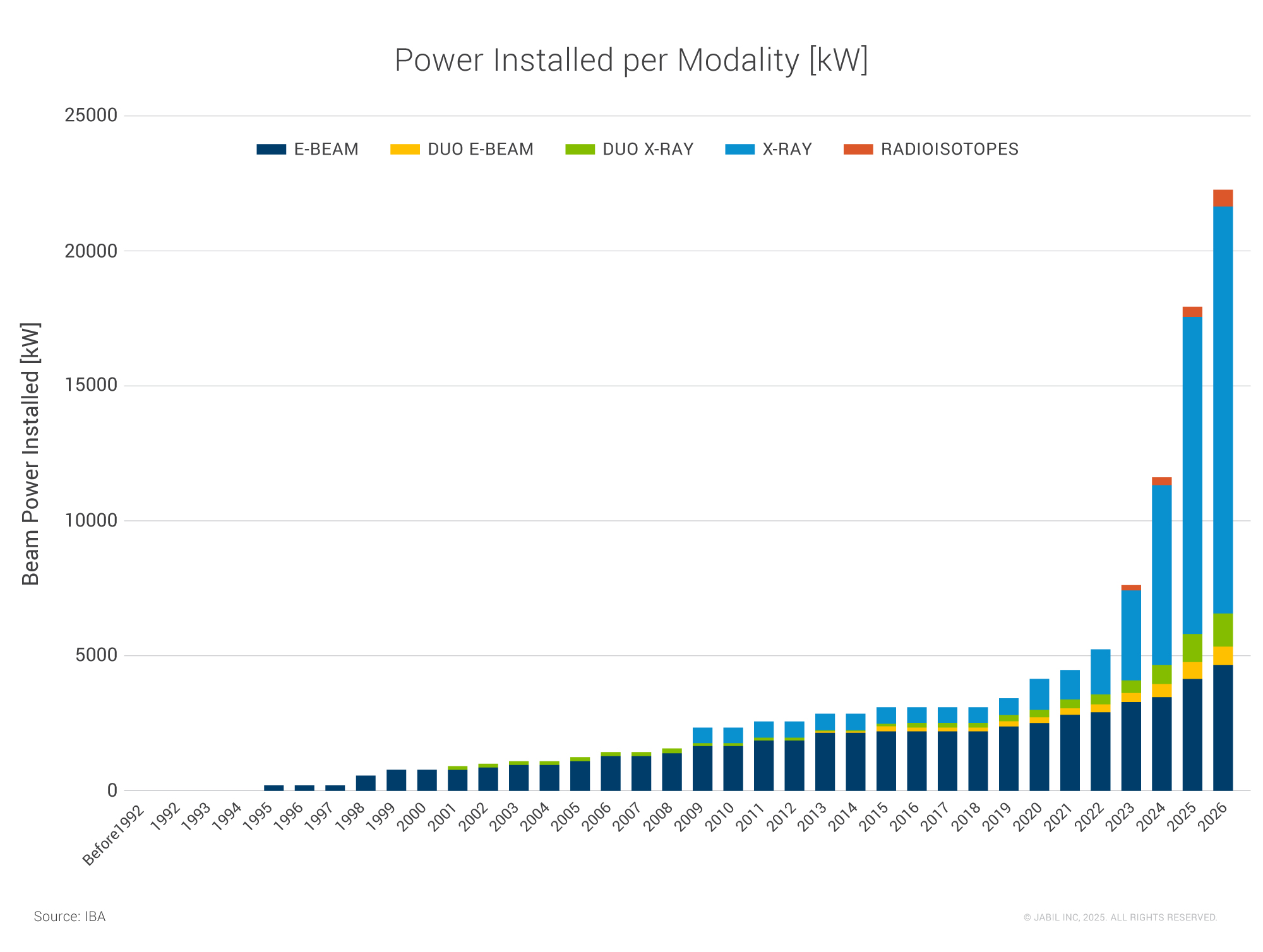
One of X-ray’s main advantages is its ability to sterilize dense or palletized loads with excellent dose uniformity, overcoming the penetration limits of E-beam without the supply chain dependency of cobalt-60 required for gamma. Because X-ray systems can be switched on and off as needed, they eliminate the need for radioisotopes within manufacturing facilities while also offering safety and sustainability benefits.
Although X-ray facilities are still less common globally, investment and adoption are accelerating as device manufacturers look for scalable alternatives that balance efficiency, environmental responsibility, and long-term supply stability. Within a multi-modality strategy, X-ray is increasingly viewed as the flexible bridge between E-beam’s speed and gamma’s depth of penetration.
Why Medical Device Makers Are Diversifying Their Sterilization Methods
In a word, the answer is — resilience.
Faced with evolving regulations, a uniquely unpredictable sterilization supply chain, and rising cost pressures across every link of production, medical device manufacturers are prioritizing flexibility. Diversifying sterilization approaches is a continuity strategy. Different modalities offer different advantages and spreading that capability across methods reduces the risk of disruption.
There are three powerful forces shaping OEMs’ sterilization strategy — regulation, product complexity, and supply dynamics.
1. Shifting Regulatory Landscape
EtO sterilization remains in a highly dynamic regulatory period — marked by critical sterilization facility closures in the United States. The EPA’s 2024 final rule requires commercial sterilization facilities to reduce fugitive EtO emissions, and, as of 2025, federal actions are delaying its implementation.
This back-and-forth has created uncertainty, but the long-term trajectory remains clear: Stricter oversight of emissions and greater accountability for community and worker safety are necessary to keep EtO a viable sterilization option. Manufacturers that invest now in process modernization and comprehensive emissions management will be better positioned for resilience in whatever regulatory landscape ultimately takes shape.
EtO will remain indispensable for many device classes. The question is how to operate EtO programs with confidence amid evolving emissions standards and community expectations. Two adaptive strategies stand out:
Modern, purpose-built abatement and facility design
Advanced EtO abatement systems are central to compliance strategies. Purpose-built buildings — with engineered airflow, sealed process rooms, real-time monitoring, and robust aeration design — help maintain safety margins while minimizing residuals and emissions.
All-in-one EtO processing
This approach combines pre-conditioning, sterilization, and aeration within a single chamber, eliminating the need for separate rooms and extended transfer times. By streamlining these steps, total cycle time can be cut by more than half — reduced from more than 50 hours to roughly 22. Loads processed under parametric release can ship directly to their final destination, helping manufacturers shorten turnaround times while maintaining strict control of critical parameters such as pressure, temperature, humidity, and gas exposure. Under parametric release, products are cleared for shipment based on validated sterilization parameters and real-time process data rather than awaiting separate sterility test results which enables faster turnaround while maintaining compliance.
2. Rising Product Complexity and Design Challenges
The industry’s shift toward more complex devices — advanced polymers, multi-layer packaging, smart sensors, powered components — demands careful modality selection. Device performance post-sterilization is just as important as the terminal sterilization process itself, especially as products move into home-use and connected-care settings where reliability and usability expectations are high.
Digital healthcare solutions and electronics-enabled medical devices continue to grow as a share of the market, bringing printed circuit board assemblies (PCBAs), batteries, sensors, and firmware into the equation. In these cases, two considerations guide sterilization decision-making:
- Thermal and moisture sensitivity is a real concern. Many electronics, adhesives, and encapsulants cannot tolerate the conditions associated with higher-temperature processes, such as steam sterilization (autoclaving) or dry heat. EtO’s low-temperature profile, combined with its ability to penetrate complex housings and packaging, often make it the preferred — or only viable — choice for devices with electronics.
- Functional performance must be preserved. The sterilization method cannot compromise signal integrity, power management, sensor accuracy, or mechanical tolerances. This is where early collaborative engineering pays off: matching the product’s bill of materials and packaging design to a modality (or two) that maintains function while meeting sterility assurance levels.
In practice, leading OEMs qualify EtO for many of their existing SKUs while concurrently exploring radiation-based options for accessories, components, or future revisions that are more materials-tolerant. That dual-track planning builds resilience without forcing a one-size-fits-all answer.
3. Evolving Supply Dynamics and the Value of Integration
Medical device manufacturers want predictable access to sterilization slots, shorter lead times, and fewer logistics handoffs. Radiation capacity is expanding but can be uneven by geography. Gamma’s reliance on Cobalt-60 is manageable with planning but remains a variable; E-beam and X-ray capacity are scaling as more providers invest in the capabilities. The practical strategy is to reduce potential bottleneck constraints by validating multiple options.
Sterilization is not an isolated “last-mile” piece of the supply chain. It influences design choices, packaging, labeling, shelf life, and logistics. Co-locating sterilization with manufacturing or within the same campus eliminates handoffs, reduces freight and queue time, and gives operations teams tighter control over schedules and change management.
Vertical integration provides another lever: the ability to combine process development, packaging engineering, sterilization services, quality, and regulatory support in the hands of one trusted partner. Beyond speed and cost, that integration lowers uncertainty — particularly helpful when validating a second (or third) modality to improve resilience. Working with a manufacturing and sterilization partner that has a globally distributed footprint also allows teams to stage capacity close to their desired end-markets and maintain continuity when regional bottlenecks arise.
What the Future Holds for Medical Device Sterilization
The sterilization market is complex and evolving. Regulatory expectations will continue to rise. Product portfolios will increasingly include sensitive electronics, smart packaging, and non-traditional materials. Global demand will stretch capacity in certain regions, whether due to regulation, resource constraints, or shifts in global trade.
The destination isn’t a single “best” modality. It’s a durable approach that ensures sterility, preserves device performance, and withstands policy, supply, and demand shocks. One certainty is that building resilience into sterilization strategies today will be what future-proofs device manufacturers for the years ahead.
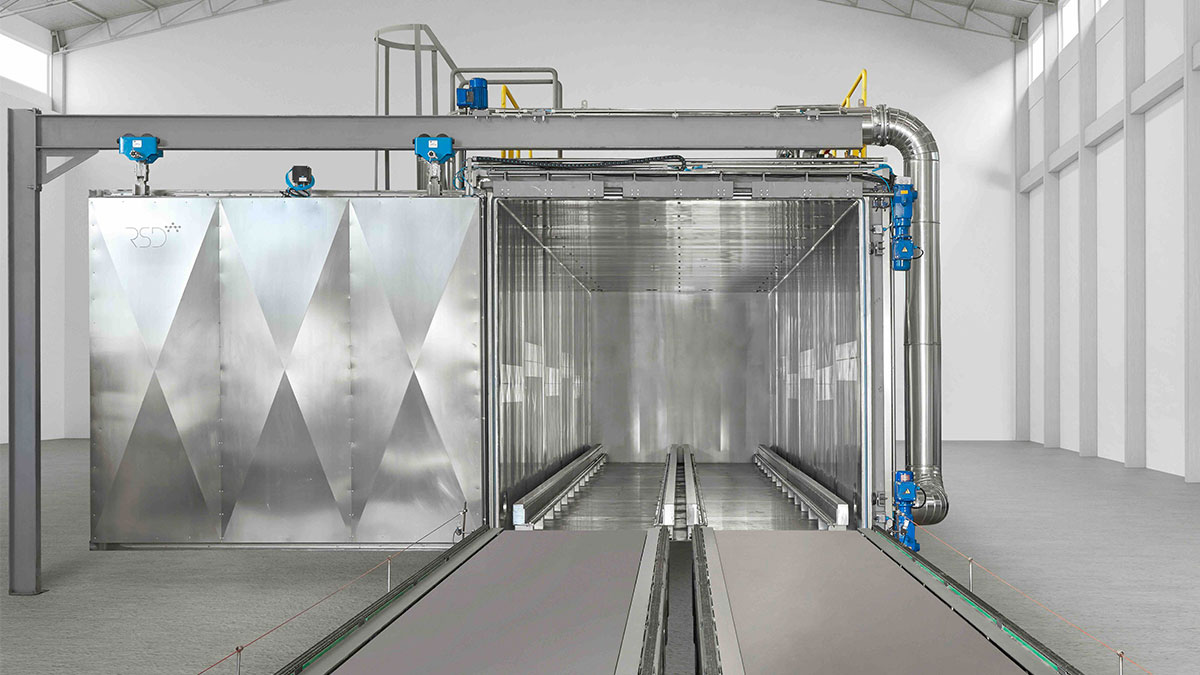
Header image courtesy of RSD, 2026.
No matter how complex or demanding the project, we're helping today's healthcare innovators solve it.
Get started with a trusted partner.